

Learning Outcomes
The following video gives a brief introduction to developing intended learning outcomes (ILOs), creating effective ILOs by making them SMART (specific, measurable, action-oriented, relevant, and timely), and using Bloom’s Taxonomy to choose your verb.
To be mindful of the allotted time to complete this module (1 hour), we recommend that you complete only the required parts of this module. If you still have time, or are feeling excited and inspired, you can use it to more thoroughly check out the optional resources.
If you wish, you can download a copy of the video transcript.
Feel free to look up (optional) resources such as University of Waterloo’s “Writing Intended Learning Outcomes”. This modified version of Bloom’s Taxonomy is also handy for getting inspired on learning activities/assessments.
Test out your knowledge by answering the questions below.
In an anatomy class, you have learned to identify a rib bone. You are asked to build on that knowledge by making a handout describing how you identify ribs, including pictures and a description (this will help you yourself understand how well you know the content).
In an anatomy class, you have learned to identify a rib bone. You are asked to build on that knowledge by making a handout describing how you identify ribs, including pictures and a description (this will help you yourself understand how well you know the content).
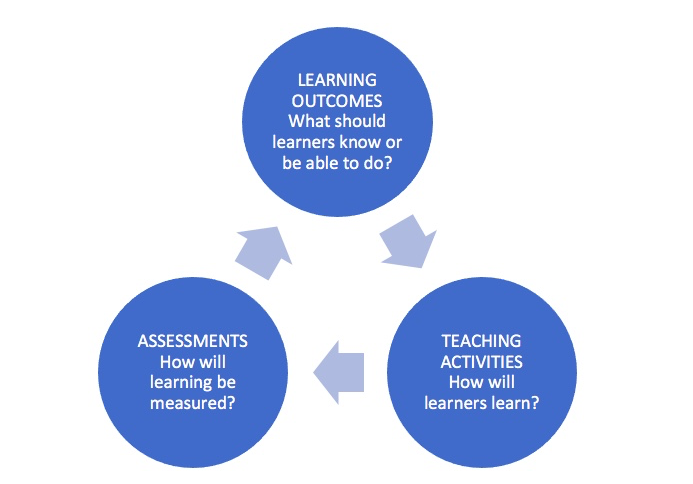
Learning outcomes are one of three elements in the constructive alignment triangle.
Constructive Alignment
Constructive alignment refers to the process of ensuring that the learning activities you select and the assessments you use connect back to your learning outcomes. Are you evaluating the thing you said your learners should know or be able to do by the end of the lesson? Do the activities selected help the learners achieve the learning outcomes? If you answer ‘no’ to either of these questions, you should revise your plan to ensure there is constructive alignment.
Test your knowledge with the following questions
Review the explanation of the course and answer ‘yes’ or ‘no’ as to whether it is in constructive alignment.
Optional: The following video briefly describes constructive alignment and how the components connect with each other in detail.
If you wish, you can download a copy of the transcript for the video above.