

Student Partners Resources
Explore these valuable resources to kickstart your Student Partner Project. These materials are designed to guide you through every step, providing essential tips, tools, and insights to ensure your project’s success.
This document is intended as a guide to follow during the first meeting of your partnership. The points listed are not exhaustive but are intended to get you started.
Dr. Antonio Dos Santos of the MacPherson Institute has conversations with student, staff, and faculty guests about the “Students as Partners” model for pedagogical research. Each episode features a special guest interview accompanied by a SaP project profile.
Navigating power dynamics in a student partnership represents a real challenge. While efforts are made to prevent staff and faculty from dominating partnerships, it’s crucial to balance guidance with giving students the autonomy to direct their efforts. Establishing effective, collaborative relationships with well-defined roles and responsibilities is essential, enabling members to seek guidance comfortably when needed.
If you seeking to make your partnership and work more equitable, please visit the McMaster Equity and Inclusion Office for more information.
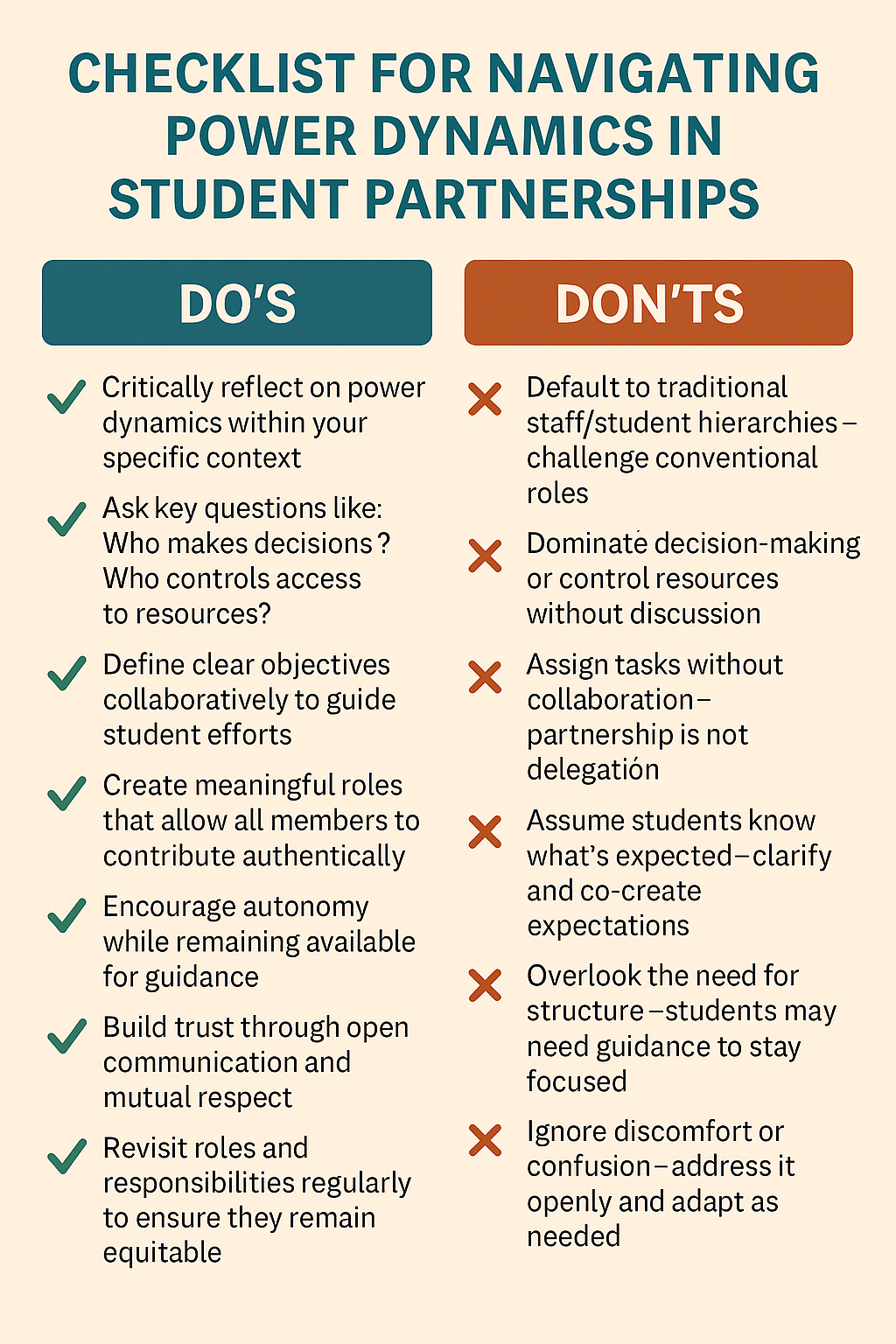
Text version of above graphic:
Checklist for Navigating Power Dynamics in Student Partnerships
Do’s:
- Critically reflect on power dynamics within your specific context
- Ask why questions like: Who makes decisions? Who controls access to resources?
- Define clear objectives collaboratively to guide student efforts
- Create meaningful roles that allow all members to contribute authentically
- Encourage autonomy while remaining available for guidance
- Build trust through open communication and mutual respect
- Revisit roles and responsibilities regularly to ensure they remain equitable.
Don’ts:
- Default to traditional staff/student hierarchies – challenge conventional roles
- Dominate decision-making or control resources without discussion
- Assign tasks without collaboration – partnership not delegation
- Assume students know what’s expected – clarify and co-create expectations
- Overlook the need for structure – students may need guidance to stay focused
- Ignore discomfort or confusion – dress it openly and adapt as needed.
Interested in learning more about partnership? Feel free to explore these curated resources.
Cook-Sather, A., Bahti, M., & Ntem, A. (2019). Pedagogical partnerships: A how-to guide for faculty, students and academic developers in higher education.
Diallo, Carol L. “How Participating in Pedagogical Partnership Helped Me Grow as a Person and as a Student,” Teaching and Learning Together in Higher Education: Iss. 26 (2019), https://repository.brynmawr.edu/tlthe/vol1/iss26/7
Elon University Center for Engaged Learning. (2013). Best Practices for Integrating Student Voices in SoTL. Retrieved from https://www.youtube.com/watch?v=11OuxzmTGso
Gourlay, G., & Korpan, C. (2018). Genuine students as partners: How a Teaching Assistant Consultant program put students as partners into practice. International Journal for Students As Partners, 2(2), 106-114. https://doi.org/10.15173/ijsap.v2i2.3567
MacPherson Institute. (2017) Perceptions of Student Partnerships – Experiences [web video]. Retrieved from https://www.youtube.com/watch?v=9aC3yv6RFOM
Mejia, Yeidaly “Carrying Partnership Skills Beyond Formal Partnerships: When Conflicts Grow into Connections,” Teaching and Learning Together in Higher Education: Iss. 26 (2019), https://repository.brynmawr.edu/tlthe/vol1/iss26/6
Mercer-Mapstone, L. & Abbot, S. (2020). The Power of partnership: Students, staff and faculty revolutionizing higher education.